2. A representative from StructuredCabling.com will contact you to learn more about your project.
(We will contact you the same day in most cases)
3. We will identify cabling contractors from our database that are the most qualified to supply you with an adequate sampling of bids.
4. We will present to you a description of each cabling contractor that we have in mind. You will be given the opportunity to choose which contractor you would like to receive bids from.
5. You will be contacted directly from those contractors to brief them further on your needs.
Things To Know!
1. This is a FREE SERVICE.
2. Unlike all other sites of this nature, we do not sell your leads to potential structured cabling contractors.
3. Since we don’t sell your leads, you will not be inundated with a barrage of calls from a multitude of cabling contractors.
4. Our goal is to find you sub-contractors who reside in your immediate area.
Are you debating over whether to be frugal and install Cat 5 Ethernet cabling, upgrade to the faster Cat 5e, or invest in the gigabit certified Cat 6 for your home or office networks? Well, today we’re taking a closer look at all three of these options and breaking down their functions and features to better help you make that decision…
Today, every office environment requires some type of voice and data system in order to function at peak efficiency. The particulars of the system will vary, based on the current and projected needs of the client. When evaluating different voice and data elements for your system, it is important to begin with the basics and then identify additional functions that will be used at least periodically. At the same time, it is important to think beyond today and make sure your system has the capability to expand as the business grows or changes in some manner…
New technology premiers daily in the structured cabling industry. It can be difficult to decide which new trends will last and should be invested in, and which ones will fall away with time. As a contractor serving the cabling community one of the most important concerns is having the right- and best – tools for the job. This means finding a reliable supplier and keeping up a good relationship with that company. Seeking a supplier who can provide bulk amounts in a timely manner upon purchase can be crucial to your success. Structured Cabling Products (SCP) is a Ft. Lauderdale based cabling supply company that keeps everything from Cat5e cables to crimping tools to HDMI and audio-visual cables in stock. They have a wide selection and a sturdy history of serving the structured cabling industry in the U.S., Europe and Africa/the Middle East.
While the thought doesn’t often occur to us, it takes only one trip to a foreign nation to realize that different electrical and technological systems are used in various parts of the world. Just try to plug in an appliance while staying at a hotel in europe and you will quickly discover that the technologies aren’t compatible. Even with the proper converters the surge protection, the wattage strengths must be considered so that you and your technology don’t get shocked. Because different regions have different systems, few cabling technologies are standardized worldwide. Compensations must be made from place to place to keep systems running smoothly and effectively.
Especially as your structured cabling business grows and become more lucrative, one of the biggest considerations for the success of the work is where and how to get your cabling materials and tools. Depending on the size and scale of your operations, keeping a stock of cables, hardware and work tools can be a wise choice. The capability to acquire more specialized cables and supplies quickly and efficiently is also a big help towards the success of installation and repairs. Because many companies that deal in the business of structured cabling do so from different angles, or concentrate on a particular area or service, the needs of each group is different.
Structure Cabling Products, (SCP) is an aptly named U.S. Cabling supply company. Founded in and operation out of southern Florida, SCP carries bulk supplies and cables for anything from computer network cabling to fire alarm security. Carrying tools, hardware and wire, Structured Cabling Products is capable of shipping large quantities all at once, allowing them to supply contractors and structured cabling companies of various sizes all across the country.
The world of structured cabling materials and products is a vast and ever-changing. Because the industry of network cabling is so quick to revolutionize in technology and systems, newer products come onto the market all the time. While there are mainstays of equipment that can be trusted and used in many different situations, keeping up with the plethora of cabling elements is an important part of the structured cabling profession. Just the tip of the iceberg, these are two categories of cabling products used by network technicians.
In the world of structured cabling, there is a wide smorgasbord of materials and equipment to be applied to the job. Different wiring, cabling, utility tools and hardware are used to solve all varieties of issues and complication in the designing building and maintenance of a cable network. These structured cabling products and materials are often classified or bulked together based on the sort of network they serve, and the kinds of construction codes they uphold. One example of these categories is Structured Cabling Products of the Plenum variety or, SCP-P.
The saying “a man is only as good as his tools” is particularly true in the case of structured network cabling. The tools and materials of the structured cabling industry are numerous and varied. From metal wiring and plastic casing to cutting and crimping appliances, the toolbox of a cabling technician is very specific to the field. While many cabling installers and techs could construct many of these materials from scratch it is cheaper for them, and the customer if they purchase these components in bulk and measure what is needed per job. Network cabling materials and tools have been modernizing and changing design as technology and information improves. However, many of the basic building blocks remain the same.
Private citizens, businesses and even large corporations and non-profits have taken a responsible interest in recent years in environmental and resource sustainability. As government funding and tax breaks encourage growth and innovation in this field, standards have been developed to ensure that sustainability is up-kept as the future unfolds. Structured cabling and network cabling in general is no exception to the run towards environmental care and energy sustainability.
Recent projections show that the network cabling industry is large and profitable and continues to grow worldwide. As the network cabling market increases over the next couple of years, a study from Bishop and Associates projects that the yearly revenue of the cabling industry will top eight billion dollars, and keep growing from their. There are several hubs or new fronts of the structured cabling game, areas where this growth is particularly felt. These new markets are good to keep in mind as technology is designed and structured cabling professionals look for new fronts to develop their businesses into.
In most situations in which information networking and structured cabling is utilized there is a fairly straightforward power source. Usually there is a hook up to a main public power line, privately paid for by the home or business owner. Because power of some sort is required to set up and run a cable network, circumstances in which electricity or power are more difficult or scant can make for tricky structured cabling work and require creative solutions from professionals.
Specialized situations require specialized attention, particularly where structured cabling is concerned. While the processes of planning and installing a cable network are complicated enough inside usual circumstances like houses and commercial buildings, it is even more difficult in unconventional set ups. There is a whole other level of planning involved in the structured cabling of outdoor projects, rare venues and high demand projects. Structured cabling engineers and technicians apply a respectable amount of cunning and adaptability to meet the demands of these special structured cabling jobs.
One of the many little known facts about the electrician trade is the high degree of training required to get to the professional level. To become an electrician in the United States there are a great deal of requirements to meet. Depending on the state in which you train and seek to work, there are several stages of training possible. Generally, you begin as an apprentice. In some places you can only be taken on as an apprentice after several years of institution-based education. You then move to on the job training. This apprentice stage adds up to around eight thousand hours of work based learning. Much of the technical skills…
With internet access popping up in almost every home and business, is is important to stay informed and up to date about different connection types and internet speeds. It depends on how your internet is cabled, but most people today receive their connection either via a telecommunications phone line or a television or fiber optic line. Either way, many servers are run through a router that projects that internet connection across space to be picked up by wireless enabled devices. Depending on how it is run, projected and received, your internet will run at different speeds. Internet speed is measured both for uploading and downloading in Mbps is MBps. Mbps translates to megabits per second and refers…
The Grounding or Earthing point of a cable or wire is usually the place at which the cable is connected to the earth and/or where the circuit completes itself and is measured. The concept of grounding came about along with the invention of circuitry, which in simplistic terms is the idea of electrical (or otherwise) currents running in a return loop, and requiring an eventual end to that cyclical journey. It was discovered that the ground was a good source to end, contain and measure those loops of power. Many types of cables are actually required, either by design or attention to safety, to be thoroughly grounded. The ground (or earth) is a relatively stable and dependable conductor of power, and a constant to measure the fluctuations of that power against…
In the world of cutting-edge and developmental cabling technologies, Fiber-Optics are at the top of the list. Most folks have heard some whisper of optical -fiber cabling and what can be used for, but the real specifics and complete rundown of the equipment tends to be more of and unknown. The general knowledge is usually that fiber-optic cable is a new and highly efficient means of transmitting information with high resolution. It is especially useful, therefore for television, internet and other visual media transmission. However, there are more questions surrounding what the cable actually is, how it is constructed and why its functionality is so good at moving data.
If you’re new to the topic, the processes and materials of structured cabling can seem daunting and, of course, seeking the right professional is key. However, if you want some basic knowledge to inform decisions about the cabling in your business or home, it makes the most sense to start with the building blocks: cables. If you are installing a new LAN (local area network) or even just doing upkeep on an existing network, it will serve you to do a bit of cable research. As stated previously, a trusted cabling professional can help you make the best decision for your particular network, and while more modern and well made cables will cost more than the lesser, it will generally serve you to go with newer technologies that will be compatible with future innovations for the longest. Whether your network requires the transfer of information via voice, video and/or ethernet, it is beneficial to have a good grip on the advantages of several different cable types. The cables examined below have been standardized and differentiated by TIA/EIA-568, which has been responsible for the standardization of data cabling since the mid-1990s. These are the network cables most popularly in use today.
Networking, Office Relocation and IT News & Articles
Regardless of the sort of business you do, you are most likely heavily dependent on your Local Area Network to get your job done. When your network has issues or complications, it can put quite the wrench in your operations. Here are four practical ways to ensure that your network and it’s future are sound.
When first implemented, LANs (Local Area Networks) were built with physical connections. Cables capable of carrying image and information connected a group of computers in one area, on one floor or in one building. As technology has advanced, the functioning definition has shifted. Particularly with the onset and mainstream use of wireless technology, the way we deal with computer networks has changed, both at home and on the job. Some networks will always need to be wired physically, mainly for the degree of security this lends to delicate and important information. However, as more business is done online, and greater scope and bandwidth are required in the corporate world, more folks are turing to wireless solutions to power their work and their lives.
One of the largest and ever growing trends in business at large is the environmental initiative. This also holds true in the structured cabling and telecommunications networking world. Globally, a turn towards green technologies and a new attention to sustainability and energy conservation has been palpably clear over the last twenty years. Larger names in the manufacturing of network technologies and materials, like Cisco and Motorola have vast environmental departments that specialize in research and development to create network equipment that makes less waste.
As telecommunication technology becomes more commonplace, the demand for workers in cabling continues to grow. It seems every home, office and business needs cabling, not only for television and phone, but also for wifi and internal computer networking. Especially if you are in the process of putting together a company to meet this demand in cabling installation, it is important to cultivate a relationship with a trusted staffing agency.
As this most modern systems, standardization is structured cabling come about not through arbitrary decision, but through necessity. In the beginning of office, home and campus computer networking, the systems were usually fairly small, or at least localized to one space. No standards of use or organization were needed so long as these systems remained small. With the natural growth of these networks, however, it became obvious to those in the business of supplying, installing and maintaining them, that some standards needed to be put in place. Standardization would be useful, if only for the reason that it would make future growth, integration and management more effective.
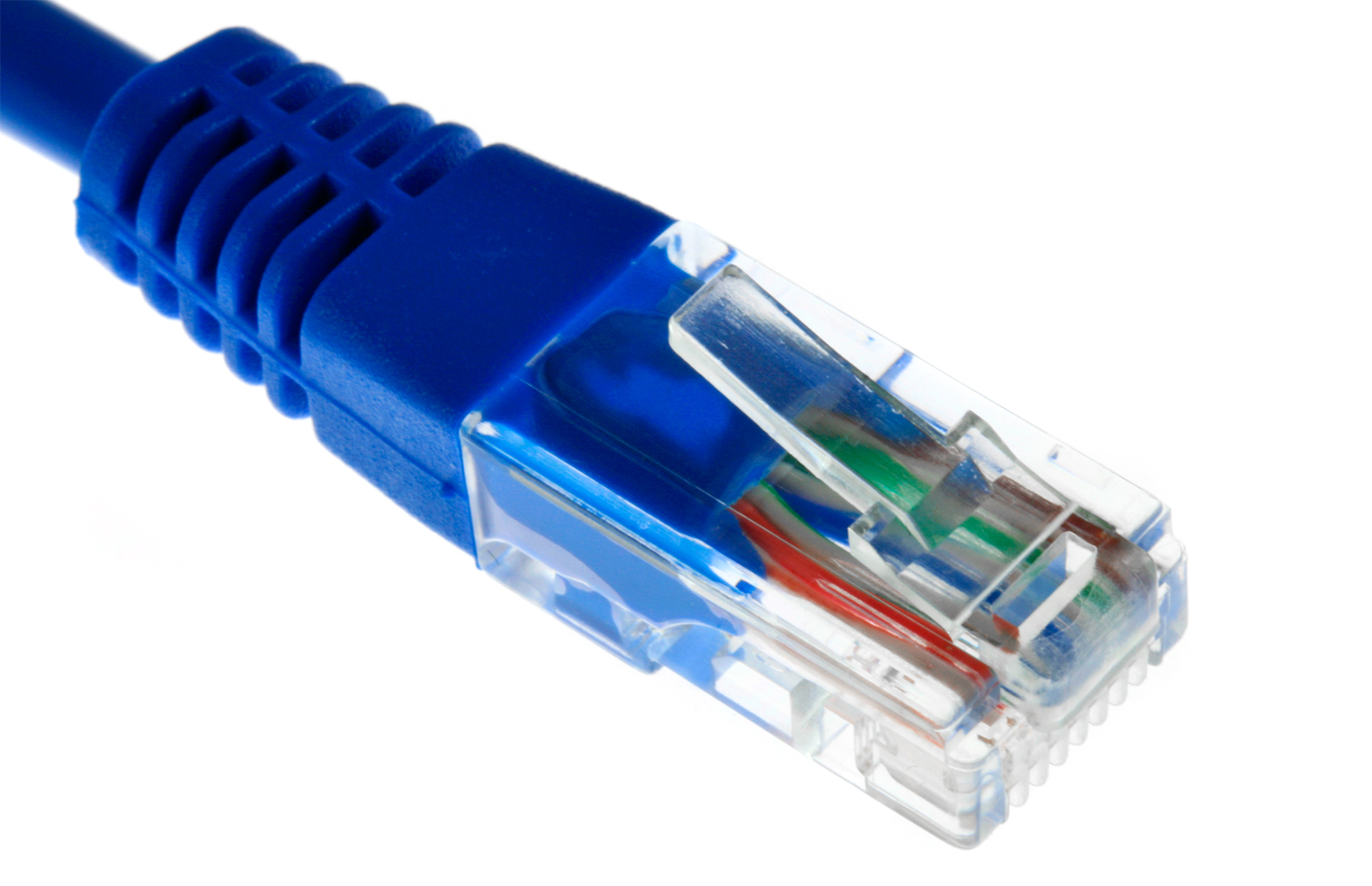
When setting up a networking system for office or home you need an appropriate length of cable. If the architecture is older, or repurposed, your building may not have been designed with networking in mind. You might need cables that are shorter or longer than standard sizes. If you go to your local electronics or computer store, they will carry 6, 25 and 50 foot pre-packaged cables. However, if you need differing lengths, buying tools in bulk and building your own will save you money, even considering that you may waste a bit of material as you learn through trial and error.
With some research, you may find that lots of people think ethernet splitters are a means by which to share their internet connection. That is, after all a logical thought. Based on the name of the tool the implication is that a Splitter could split anything ethernet-related. Unfortunately, it is assumptions like this that leave many consumers staring in vain at their computers wondering why the ethernet splitter they just purchased won’t do what they think it will.
If you work at an office or business that uses an LAN (Local Area Network) you may understand the way such networking functions to connect you to your colleagues and help you do your job. However, depending on your level of tech-savvyness, you may have less knowledge about the mechanics of such networks and how they work in a physical sense. The Ethernet LAN was conceived and invented in the 70s, and by the late 80s most businesses employed some form of ethernet networking. Originally, ethernet had several competing networking types: Token Bus and Token Ring, but won out quickly due mostly to the adaptability and convenience of the cabling systems involved.
One of the most popular applications of computer technology, especially in corporate settings, is computer networking. These internal networks allow companies to maintain consistent communication from within, usually carrying email servers through which most business is done. One of the first means of networking is a T1 system, which works like an internal phone system…
With an ever changing world of technology, schools are starting to feel the pressure of being left behind in an age of wireless everything. While some schools are proactive and have incorporated WiFi to try to keep up with the technology curve, many are only now considering the integration of WiFi due to loud and repeated requests from the student body.
So you’ve figured out that you enjoy working with your hands and perhaps you even excel at math or physics. You love electronics or computers or even just cable tv, and you can handle people. A career in cabling can be very fulfilling, but you want to make sure to choose the right path for you, and not just settle for the first decent paying job that comes your way. There are a lot of different options out there, and you need to match your skill set and preferences to what is available.
The cloud is still an airy place that many are hesitant to ascend to. But no one can deny the huge growth in successful cloud computing in the past few years. It offers companies more freedom at less cost, and will soon be the most popular way to do business. However, with this jump into the cloud, traditional Ethernet is no longer the best solution. Many who use virtualization and cloud computing are switching to a new technology called Ethernet fabric.
Though Plexxi was only officially founded in early 2011, it has been operating in stealth mode for the past few years, cooking up new and astounding technological inventions. Their latest product to hit the market may give network cabling companies a reason for pause, as it is the first step in moving away from sole reliance on cables in a network.
Cloud computing is gathering popularity and is becoming the networking wave of the future. Both IT professionals and network cabling technicians alike need to embrace its growth and quickly understand what it means for their business. With the need for speed and agility at an all time high, technology is struggling to keep up to make the ever in demand cloud services function easily and efficiently.
In today’s industry, there is contention over which cables should be laid where, what cable is best for which applications, and what is the best bang for your buck. The reality is, that most enterprises barely pay attention to the kind of cabling that is being laid for their IT network, and are just trusting the technicians to give them what they need. As cabling is the support system for every thing from business services to bring your own device policies to cloud access, it might be an intelligent idea to start paying closer attention.
The goal for just about every business is to have a well-managed network. The roadblocks in achieving this goal come in many forms — faulty installation, electronic interference, human error. These issues can each be addressed individually, but often problems persist. One approach to a smooth run network that is often overlooked is cable management. In addition to organization and system alerts, the goal is to have the network run quickly while forming a better alignment between the IT and business operations. In order to achieve this, you need to understand that network management is a combination of a quick, flexible infrastructure and an intelligent infrastructure. It is having these two elements work together that enables businesses to run efficiently and without breakdowns.
CSIRO’s Sustainable Agriculture Flagship in Australia has taken on the task and invented a device to implant inside a cow’s stomach. This “gas-sniffing submarine” will employ infrared sensors to record any methane emitted and will be connected to a wireless network to transmit data. The device also has wings attached that will unfold inside the belly of the cow to stop the submarine from traveling past the rumen — which is where the gas comes from.
Network cabling is a very tricky operation. If you’re not armed with adequate knowledge and training, it’s incredibly easy to make mistakes and unknowingly sabotage your entire system. Even with a solid background, technicians are facing such a wide variety of different technologies, that its easy to have discontent systems or unhappy pairings when installing network cable. Here are some of the most common things network cabling technicians tend to forget.
When you are dealing with a home theatre system, one of the most confusing aspects always seems to be the ridiculous myriad of different colored cables that need to be plugged into a precisely changing location in order to make anything work. Thankfully, technology has made some leaps and bounds in this area, and now there is HDBaseT technology available for use in your home or commercially.
From a technological standpoint, for most businesses, CAT5 cabling is just no longer cutting it. Companies need more bandwidth and better reliability. The current market just can’t justify crosstalk and return loss making a mess of a system anymore, now that there are other options available. CAT6 cable is improving transmission performance and reducing near end cross talk (NEXT) with every properly installed system. It is definitely thought of as the choice for new installations.
We’ve come a long way since the days of coax cables running at a top speed of 10MB/sec. In some instances today, cables are not even required and everything can be done wirelessly. However, for most systems outside the family home, cabling is not only recommended, but generally necessary. In most existing structures, Category 5 (CAT5) cabling is the standard, but with the changing technology landscape, there is a strong case to be made for cabling all new systems with Category 6 (CAT6).
There are so many different kinds of cable on the market for transmitting data, that it can be quite difficult to discern which is best for your particular project. This article will deal with the similarities and differences between Category 5 (CAT5) cable, Category 5e (CAT5e) cable, and Category 6 (CAT6).
For those of you enamored with the world of communications and cabling, the amount of career options at your fingertips can be a little bit staggering at times. However, within this myriad of options, some believe that once a path has been chosen, there is only one way to achieve the necessary training. For network cabling technicians, at least, this couldn’t be further from the truth.
Hurricane Sandy hit hard and her effects are still being felt by many, especially in New York City. The entire downtown region of Manhattan was basically impassable and thousands were without power. On Monday October 29th, Con Ed cut power to lower Manhattan as an attempt to save the power grid while thirteen feet of storm surge assaulted the city. Con Ed has been working around the clock, and while most facilities have been able to regain heat and lights, data center providers and web hosts are still experiencing issues with their systems.
When a hurricane comes racing through town, people are generally thinking of the basic amenities like food, shelter, and warmth. Once these necessities are taken care of, it’s time for most to relax on the couch with a stash of candles, a good book and a warm blanket. The power may go out, and there’s not a whole lot anyone can do about it. Well, network cabling companies were trying to prepare as much as possible for the wrath of Hurricane Sandy, to minimize damage and wait times in the aftermath. This begs the question, what can network cabling companies do to prepare for something like a hurricane?
Network cabling installation has enabled many companies and public corporations to carry out their activities smoothly. Such companies have witnessed an increase in their competency while improving how they activate their daily routines. It is through the input of a network cabling contractor that a firm is able to link with exterior infrastructures. Computers, printers, the Internet and other hardware in an organization are able to connect to one another thanks to cabling services from network cabling companies. Increased bandwidth probability and cabling are the other advantages that accrue to individuals or organizations that engage the services of a network cabling installer.
The importance of network cabling installation in many businesses and public institutions cannot be understated. Cabling is needed in improving the day-to-day activities of the organization while sustaining competency. Organizations that undergo proper network cabling are usually connected efficiently to infrastructures in the outside world—this is helpful in spreading their business tentacles. Cables are links that connect the Internet, printers, computers and other hardware on one network. Thanks to the input of an experienced network cabling installer, such agencies in need of these services can also benefit from increased probability of full bandwidth and cabling.
Network cabling, also known as structured cabling, is a system designed for information to be transported from one device or location to another. Usually, a specific environment is involved in the process, whether for a small business or enterprise level systems network.
Computers and their data have become such an integral part of business and daily life that it is inconceivable to imagine the world without them. Networks are in every place from home and business environments to entire cities as an essential part of government operations.
Every four years, the United States comes together in adversity for 90 minutes to view a dueling dialogue between those who will one day lead us all. This year, the final debate between presidential candidates before the election was held on Monday, October 22nd at Lynn University in Boca Raton, Florida. Even more amazing than the way the presidential nominees treated each other during the final debate, is the amount of people that were able to watch it happen – thanks to a highly sophisticated network cabling system provided by Corning Cable Systems.
With the internet as a constant source of information, plenty of people are leaning towards the DIY category when it comes to technology projects, including network cabling. Attempting to install cables yourself can definitely be cost effective, but it might be at the price of your sanity. Finding a network cabling solution that actually works is a demanding and exacting process involving many steps. Many people who start a project end up abandoning ship in the middle and calling an expert. Whether you’re doing it at your home or someone else’s here are some cabling tips for both network cabling professionals and wanna-be aficionados.
A wide area network covers a big area geographically, like a province or a state, sometimes even a country. Some companies, like AT&T have a wide area network, or a WAN, that covers the globe. These WAN’s are constantly being upgraded and optimized, which essentially means trying to make the transfer of data more efficient. Companies like Lantiq, Cisco, and aClera are leaders in the world of WAN optimization.
Proper grounding and bonding ensures the safety of personnel and the protection of equipment. However, in the healthcare environment, protecting the equipment which supports patient monitoring and life support makes it again a safety issue. Coordination between electrical and telecommunications bonding and grounding systems is essential during design and installation of structured cabling, because bonding and grounding systems within a building shall have one electrical potential. The best way to coordinate these efforts is to follow industry-established codes and standards that you you should be familiar with as well as recent developments that affect all designers and installers. Here is a quick rundown of these codes and standards.
When hanging out in a room of technologically savvy individuals, it’s pretty standard for those few of us near computer illiterate people left in the world to sagely nod our heads and go along with whatever is being said. ‘Oh, your patch cable is malfunctioning? I hate it when mine do that — especially the purple ones.’ Hopefully, the next few paragraphs will give a basic understanding of network cabling and structured cabling systems. You may still sound a bit like an imbecile at a nerdy party, but at least you’ll be able to grasp the basics in the conversation.
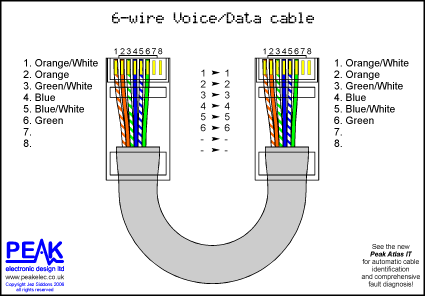
For the majority of Americans, network cabling is a large meandering mess of snake like equipment that is supposedly what makes things like phones and computers function. Most people have absolutely no idea how everything fits together or what is needed to make the most basic office run smoothly. Even office managers will be hard pressed to tell you the difference between things like regular voice grade cable and CAT3 cable. With the jargon being so foreign, voice and data cabling companies have to take the extra step to explain their services to clients.
If you have voice grade wiring that is in need of more data space, and would like it to have the ability to have a service reach further than ever before, then look not further — ActivReach is here. ADTRAN, Inc. is one of the leading voice and data cablingcompanies and has introduced this new technology in a product called the NetVanta 1535P Gigabit Ethernet switch.Many older structures, especially office buildings, have been previously wired with what is called voice-grade cable. This is generally a kind of 100 ohm twisted pair cable. Many companies tend to try using this as a medium for LAN since its already been installed. But this limits the rates for data and distance. People quickly began finding the need for data rates much higher than the 1Mbps to 16Mbps that were common. After 1995, once the Commercial Building Telecommunications Cabling Standard had been revamped by the Electronic Industries Association, the most common UTP cabling became Category 3 that could handle up to 16MHz in transmission.
This year, for the first time ever, multiple vendors worked together to deploy a public safety LTE for the Republican National Convention. The law enforcement agencies in Tampa Bay, FL were able to share voice, video and data communications using smart devices over a private, multiple vendor 700 MHz LTE network. This is the only time that federal, state and local law-enforcement agencies have used such a network for a National Special Security Event.
Fiber optic cables are everywhere, installed along roads and train lines, in buildings and under streets. And U.K. scientists have found a way to turn any length of fiber optic cable into a kind of microphone or remote sensor. They have decided to call it the “world’s nervous system.”OptaSense, a part of Qinetiq, has decided to call this new technology Distributed Acoustic Snesing, or DAS. This DAS enables companies to keep a watch on extremely long stretches of cable like railways, pipelines, and roads, in one area watching over a pipe almost 700 km long. With DAS, you can place a microphone every 30 feet.
Datatrend Technologies is now trying to measure and analyze customer behavior and footfall traffic. This network and cabling infrastructure services provider has expanded its structured network cabling solutions portfolio to include Traffic Analyzers. A traffic analyzer is a kind of foot traffic measurement system, kind of like a people counter, but it includes the report and analysis of traffic data, often through a managed service….
Fluke Networks has reintroduced the OneTouch AT Network Assistant troubleshooting tool. This tool is ideal for network managers who find themselves routinely sending front-line technicians on desk-side calls to try to fix possible network connectivity issues…
A teacher in a cardigan at the front of the room, twenty desks lined up in neat rows, a slightly dusty chalkboard on wheels in the corner, a large desk piled with mounds of papers. The traditional school room conjures up images that may no longer be helpful for students of today. Children of today are dependent on technology, and their schools are quickly becoming the ones in charge of teaching them how to use it. We would grumble through a typing class, happy to get back to writing notes to our friends, but our children may soon be sitting in front of screens instead of teachers, happy to get back to texting their friends…
At the BICSI Fall Exhibition this past week, Transition Networks Inc. is launching their new line of power sourcing equipment. These PSEs are designed to extend the benefits of Power-over-Ethernet Plus, or the PoE Plus, to high availability devices at the edge of networks in many different environments. These new products will work according to the IEEE 802.3at PoE Plus standard, providing 30W of power per PD. These new switches, converters and injectors are now able to power the latest in Wireless Access Points, or WAPs, PTZ Security Cameras, IP print servers, WiMAX Transmitters, biometric sensors, Notebooks and Video-Phones…
Many times we have all entered a building, especially a high-rise, and instantly experience dead zones with cell phone signal. This also creates a serious problem for our public safety first responders. The radio signals have to pass through various materials before reaching a receiver’s antenna. Many modern buildings erected with steel and low-e glass are notorious for lowering the signals…
StructuredCabling.com is a hiring service for structured cabling contractors in the United States and Canada. Also referred to as Network Cabling, or voice and data cabling, these specialized contractors deal with low voltage cables and wiring that connect computers, phones and data lines throughout commercial offices.When you need a contractor to install Network Cabling or voice and data cabling, you want to know your options. You want to get the best people. Installing new structured cabling is a big project critical to your company’s functioning, the results of which you’ll likely be stuck with for the next five or more years. In today’s information economy, your network cabling installation is as important as the road outside your office. It connects you to your clients and the world.
The structured cabling infrastructure is the common thread for Communications Cable Plant, Data Systems, Voice Systems, Communication Services, Integrated Audio Video Systems, Distributed Communication Systems, Intercom Systems, Dictation Equipment, Paging Systems, Public Address, Other Audio systems, Sound Masking, Electronic/Digital Signage Systems, Tracking Systems, Video Systems – MATV, CATV and CCTV, Internal Cellular, Internal paging, Healthcare Systems, Nurse Call, Hospitality and Entertainment Systems, Clock Systems, Access Control, Electronic Surveillance Systems, Intrusion Detection Systems, Detection and Alarm, Personal Protection Systems, Integrated Automation Instrumentation and Control….
Research shows that half of all network problems arise from issues in the physical infrastructure. Yet the physical infrastructure is largely overlooked. Developers are slowly embracing the idea of technology infrastructure as an integral part of building design, a practice that is routine in some parts of the world but still an after-thought in many construction projects today. I embrace the challenge of educating Architects, Building Owners…
If your business is moving into a new location or is about to update the voice and data network in an existing facility, it’s important to work with the right network cabling installation company. As with any business arrangement, you want to make sure the outcome is in the best interests of the business operation. Choosing the right installation company will mean your network will be good to go for four to five years before another upgrade is necessary….
Unless you want to be constantly installing a new voice and data network infrastructure, it’s important to take some time and determine the type of network cabling and wiring strategies that will serve your business well for the next several years. In order to manage this task, it is very important to consider short-term and long-term needs and in terms of changes in the corporate working environment, advances in technology that will affect how your industry functions…
Network Cabling is also knows as Structured Cabling. Network cabling design and installation is governed by a set of standards that specify wiring data centers, offices, and apartment buildings for data or voice communications using various kinds of cable, most commonly category 5e (CAT-5e), category 6 (CAT-6), and fibre optic cabling and modular connectors. These standards define how to lay the cabling in various topologies in order to meet the needs of the customer, typically using a central patch panel (which is normally 19 inch rack-mounted), from where each modular connection can be used as needed. Each outlet is then patched into a network switch (normally also rack-mounted) for network use or into an IP or PBX (private branch exchange) telephone system patch panel…
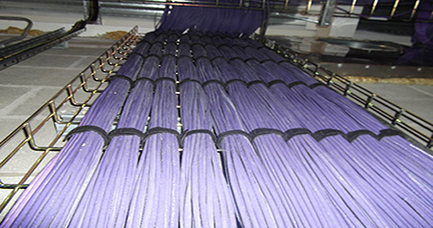
A Structured Cabling system refers to the complete network of low-voltage wire (cabling) and the hard within which it resides. The hardware consists mainly of racking, raceway (cable trays) and sometimes conduit depending on the local requirements. A structured cabling system is the infrastructure that all voice and data systems require to operate. Examples of voice and data systems that run on structured cabling networks are telephone systems and local area computer networks commonly referred to as a LAN (Local Area Network). Structured cabling systems primarily exist within an office space in all …
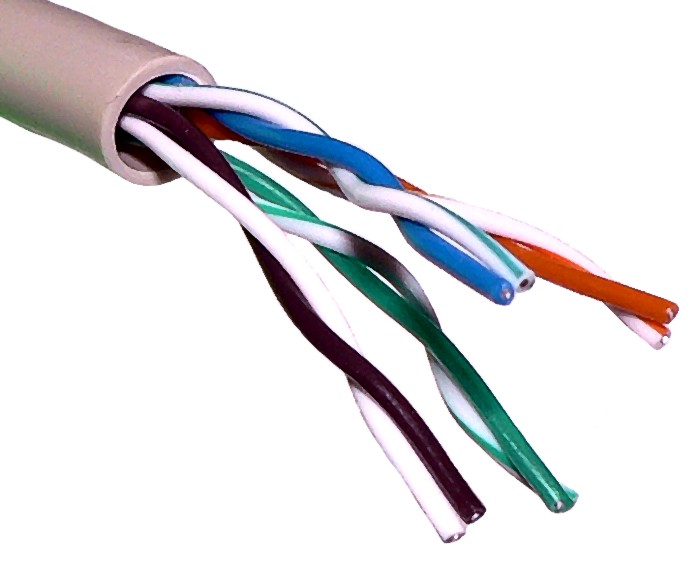
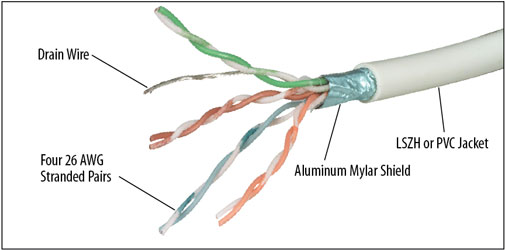
Category 5 cable (Cat 5) is a twisted pair cable for carrying signals. This type of cable is used in structured cabling for computer networks such as Ethernet. It is also used to carry other signals such as telephony and video. The cable is commonly connected using punch down blocks and modular connectors. Most Category 5 cables are unshielded, relying on the twisted pair design and differential signaling for noise rejection. Category 5 has been superseded by the Category 5e (enhanced) specification…
Structured cabling contractors are communication professionals who aid in the design of voice and data systems found in settings such as offices, municipal buildings and other types of commercial settings. The general idea behind hiring a cabling contractor for this type of system is to ensure that the combination of hardware, software and wiring used to create this internal network is in harmony with the standards set by the Building Industry Consulting Service International (BISCI)….